History of the Building
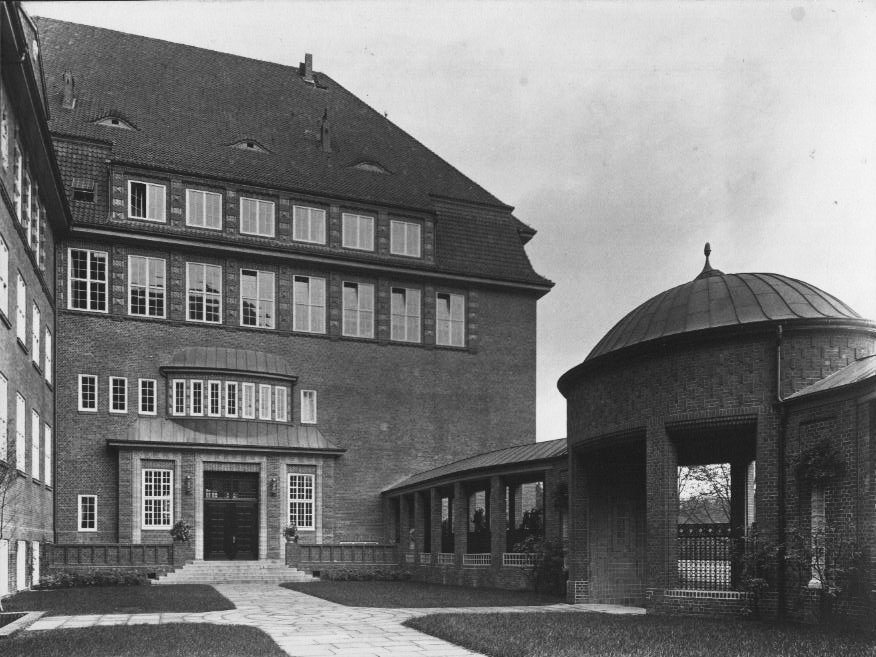
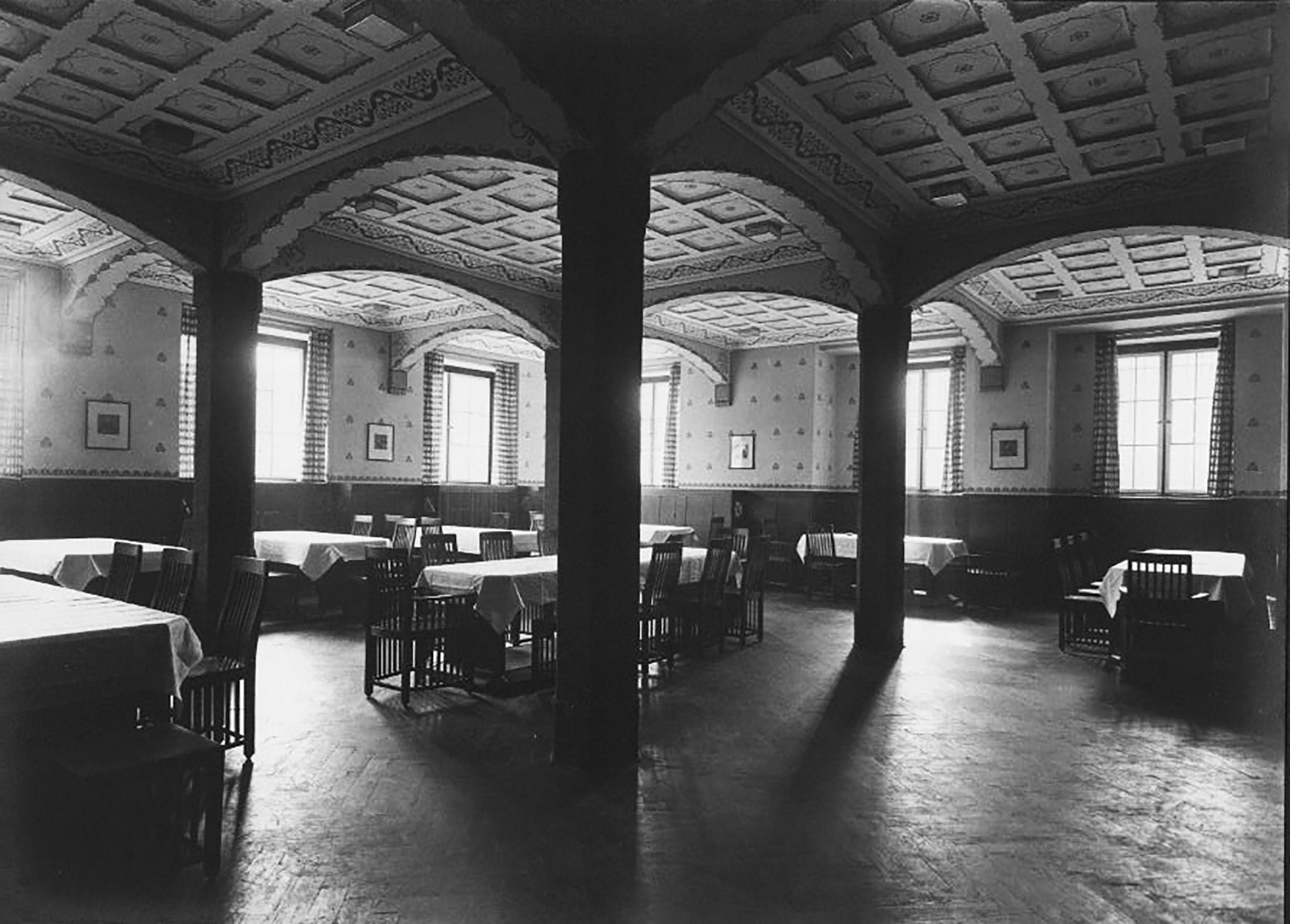
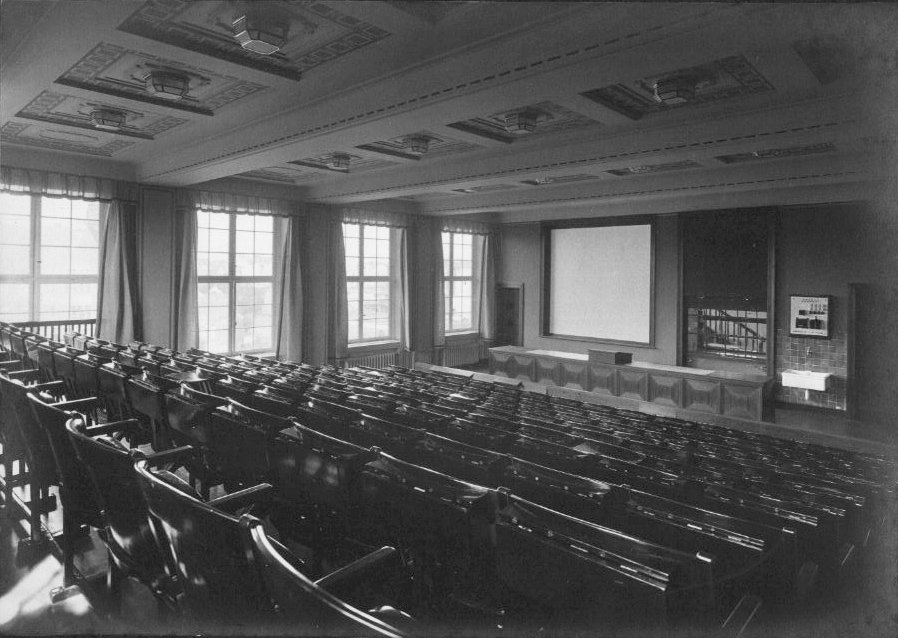
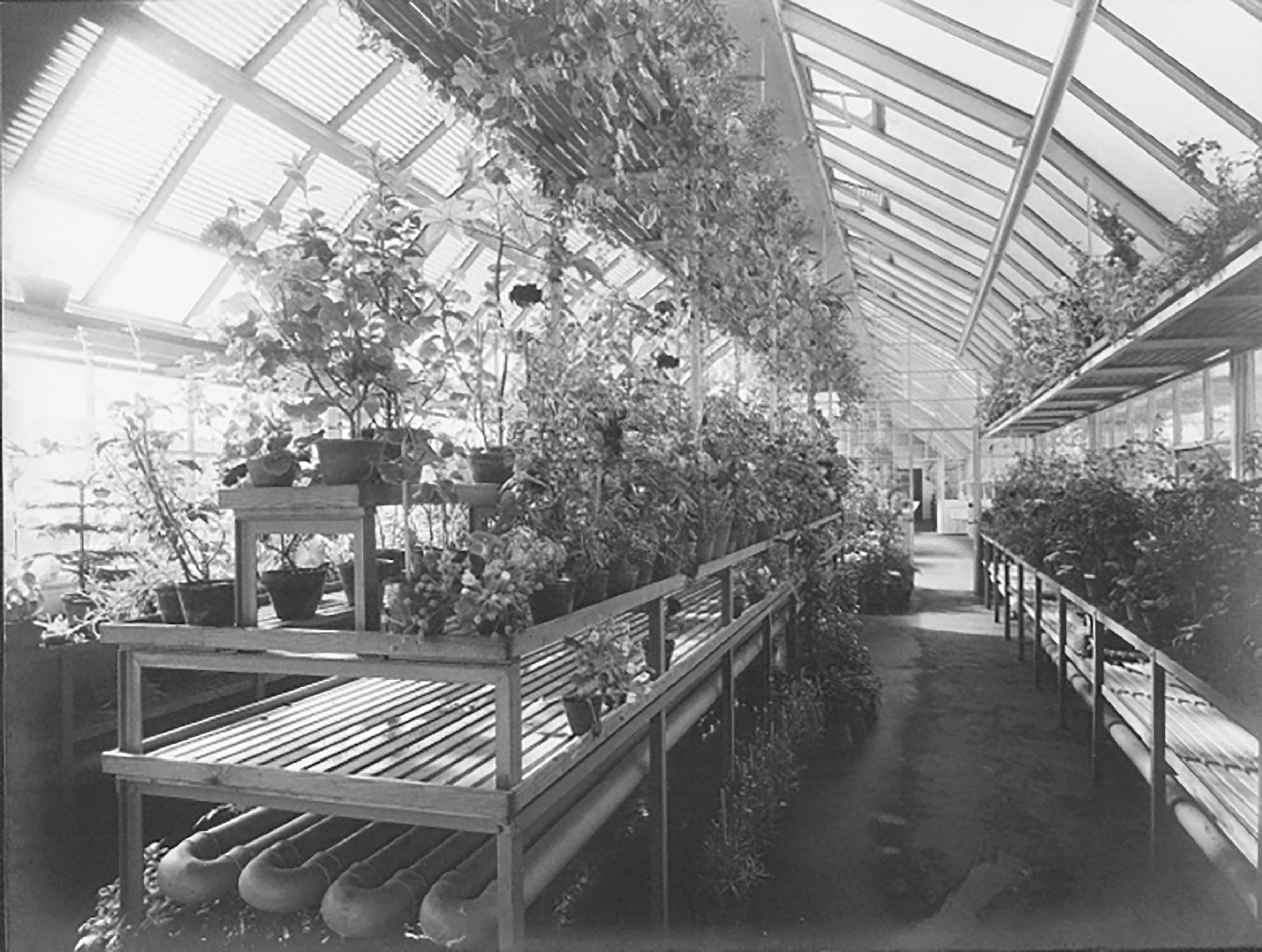
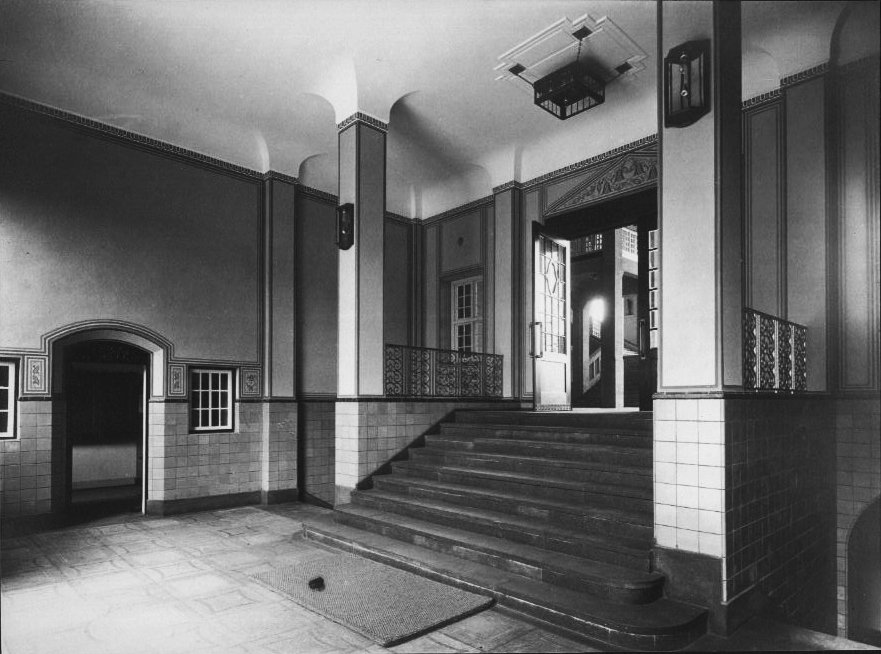
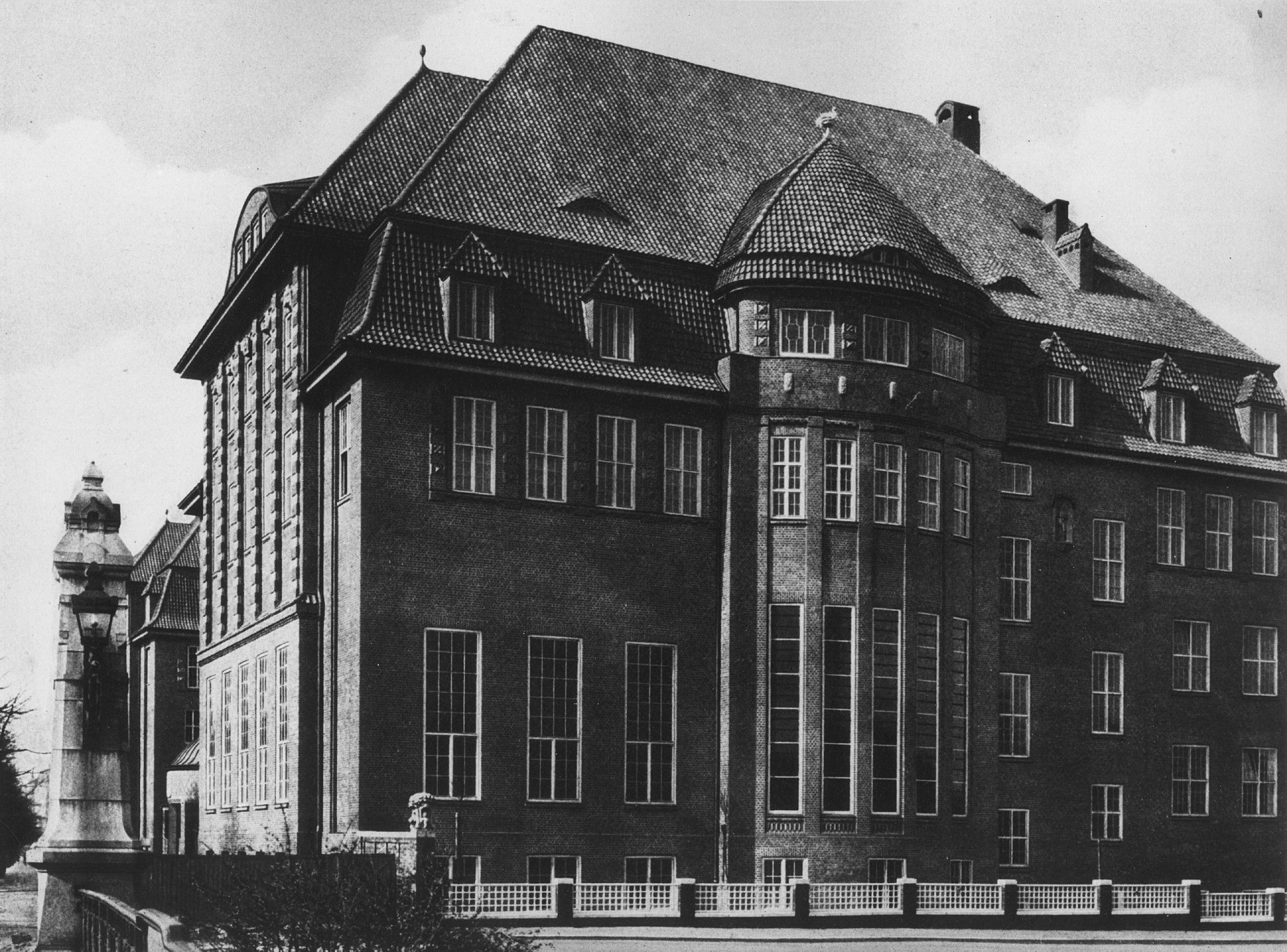
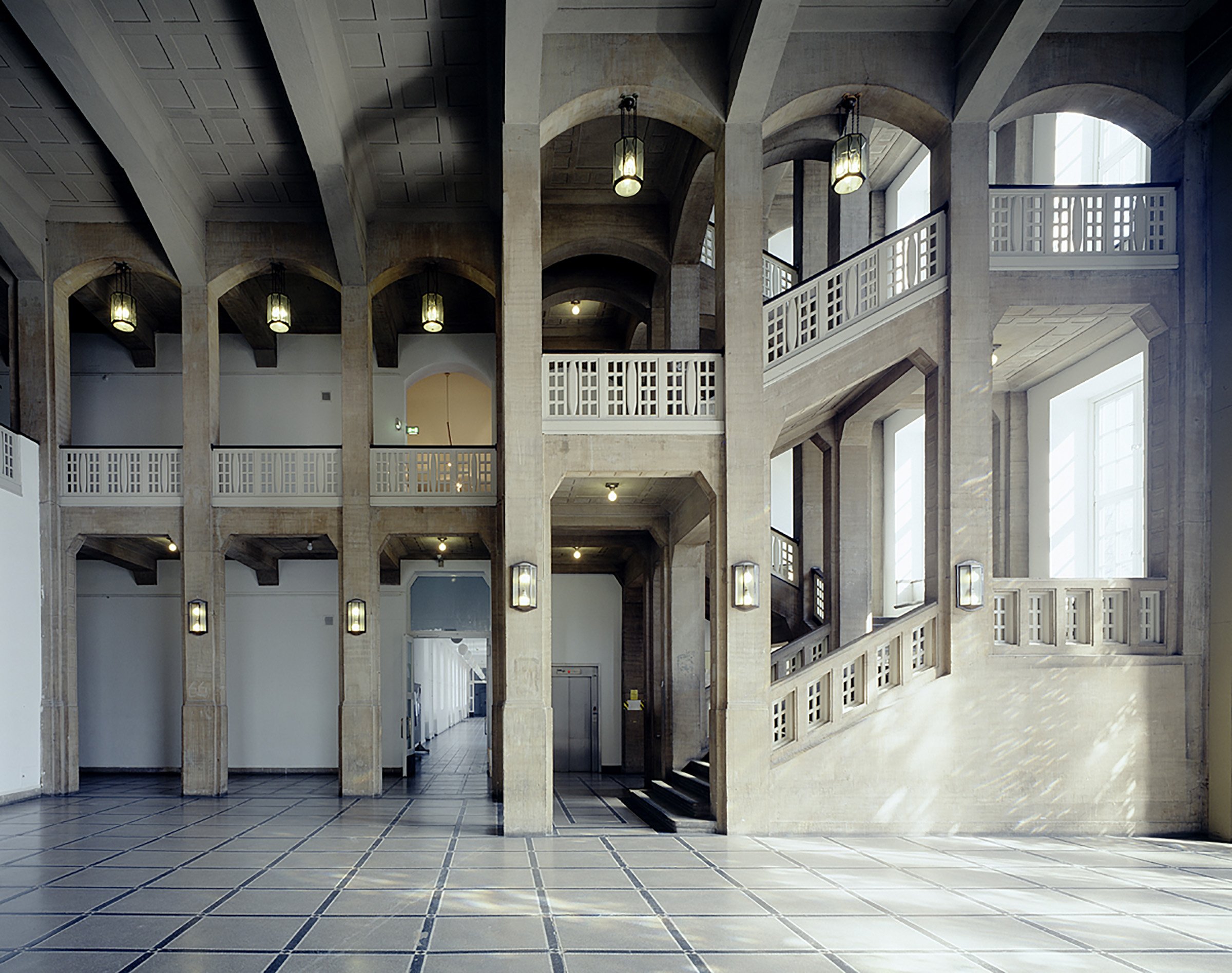
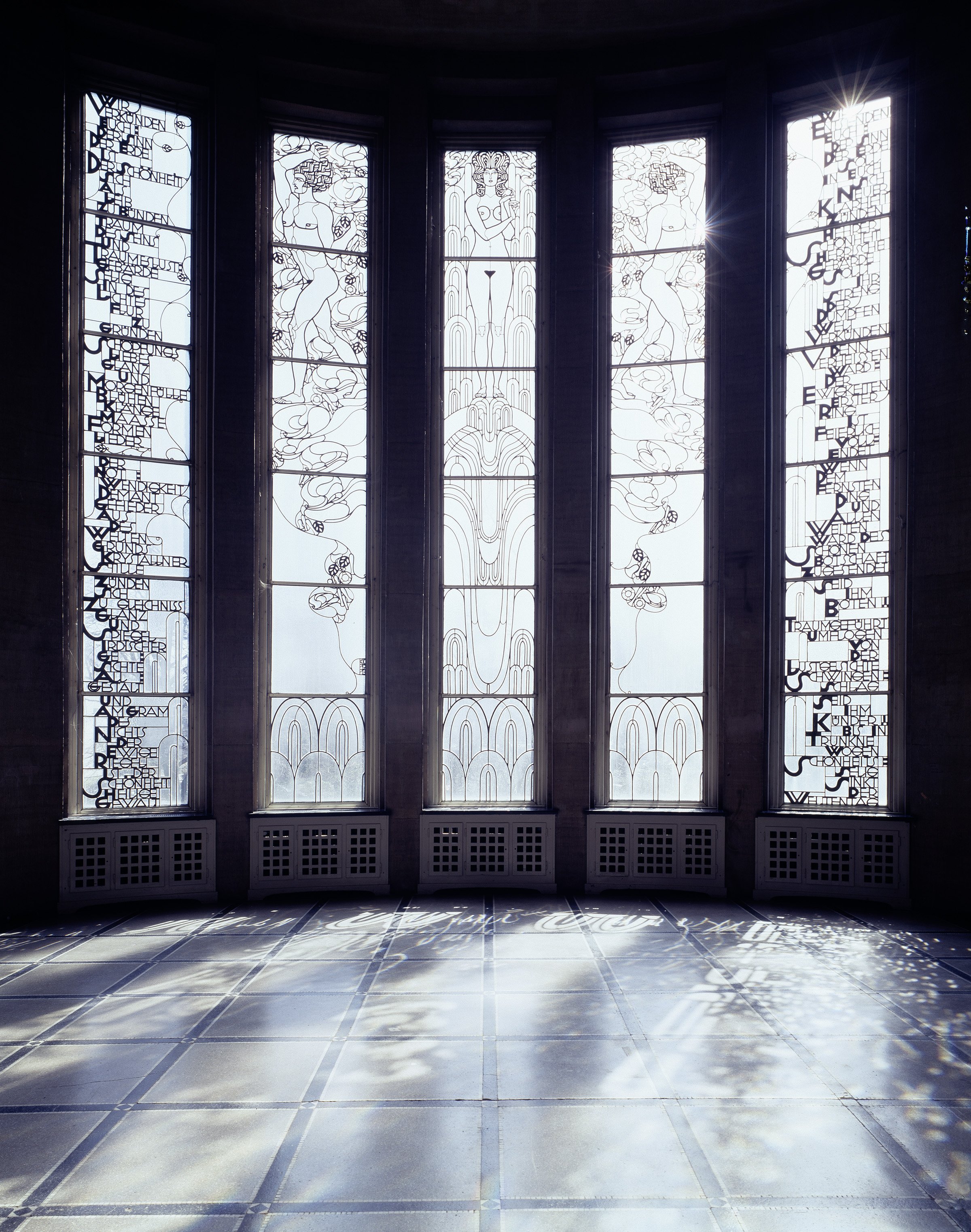
The current main building of HFBK Hamburg was built between 1911 and 1913 for the former Kunstgewerbeschule in Hamburg-Uhlenhorst at Lerchenfeld 2. It was commissioned by the Free and Hanseatic City of Hamburg.
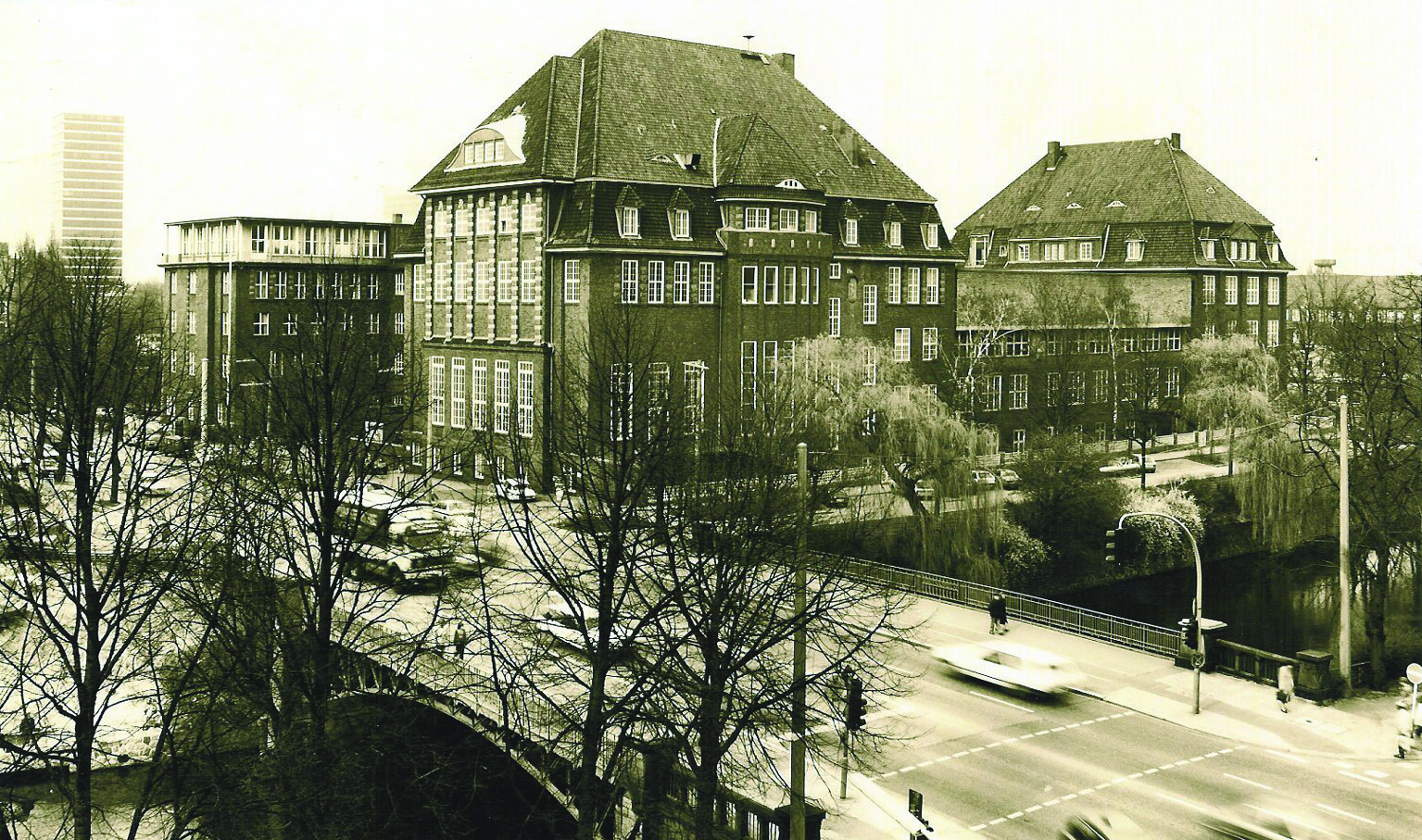
Fritz Schumacher placed the dark brick building complex with its high mansard roofs in a prominent location on the waterfront (Kuhmühlenteich), visible from afar, with the express intention of distinguishing it from the other school buildings in Hamburg with a “different, more festive character.”
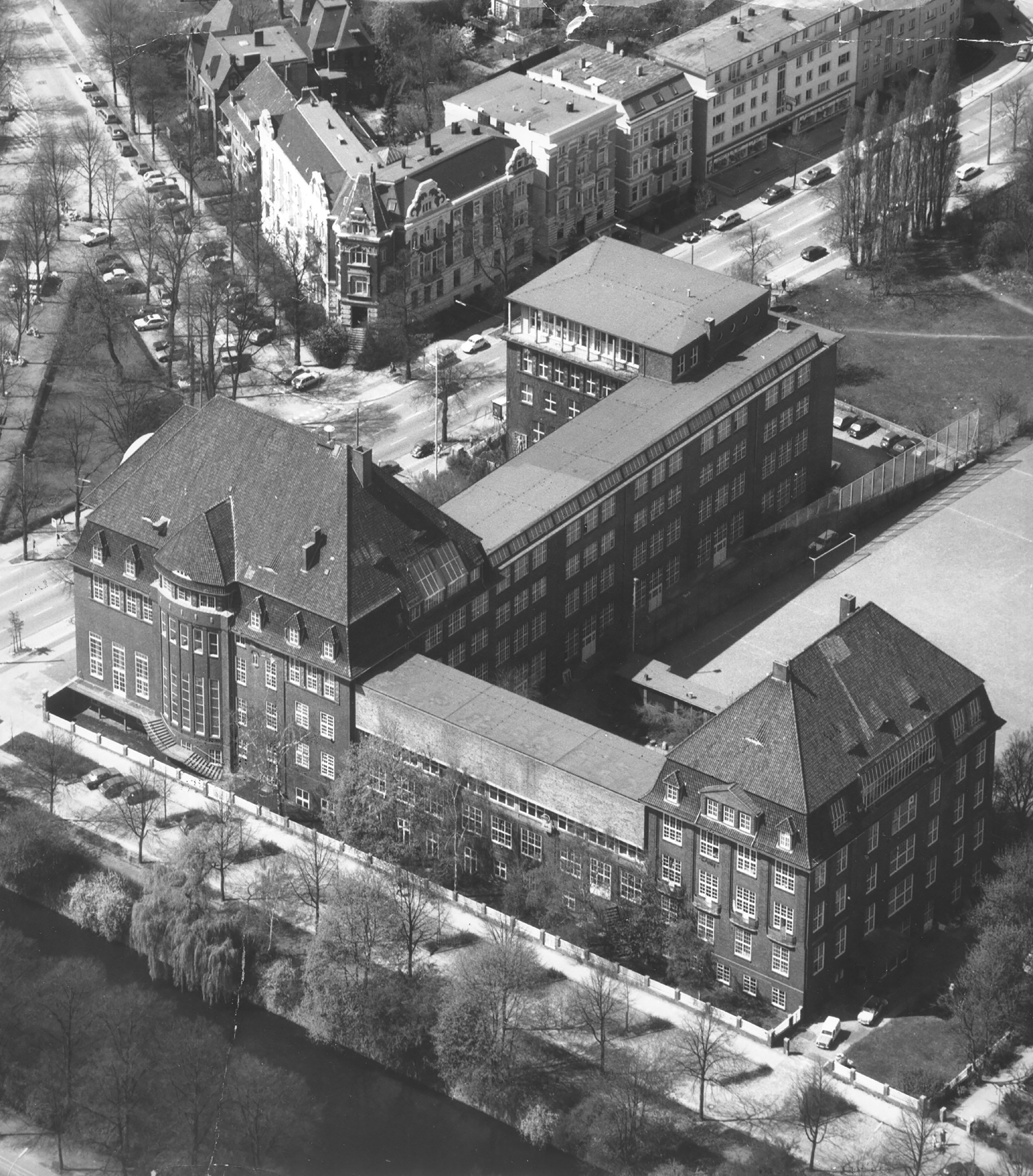
The core of the complex is a horseshoe-shaped structure on Lerchenfeld with a “decorative courtyard” in front, separated from the street by a colonnade, which was originally entered through a small oval pavilion. From there, one enters the main building on the right and steps into the high entrance hall with its solemn, austere effect. Here, a type of space developed in Schumacher’s early villa designs reappears in an enhanced form: a rectangular, high-ceilinged hall, which receives its light from an equally high group of windows on the narrow side. In the two-story hall with an open staircase on the side, “the skeleton of the reinforced concrete construction” is deliberately left visible, with concrete parts scarred on the surfaces.
The arrangement of the building wings on the angular plot is based on their functions: the location and length of the horseshoe-shaped building, for example, made it possible to accommodate many studios on the rear side facing away from the sun. The separation of the workshop wing adjoining to the east served the purpose of shielding the studios and classrooms from machine noise and vibrations.
The demands of the movement to reform art schools, which had been active since 1900, focused primarily on hands-on workshop instruction. The new building on Lerchenfeld was equipped with all kinds of workshops (printing, sculpture, photography, goldsmithing, pottery, hand weaving, carpentry, etc.), which were considered exemplary in 1913 and made Hamburg an important center of reform at the time.
The school’s teachers contributed to the artistic design. Richard Luksch created the large ceramic reliefs on the sides of the entrance pavilion, a mother-and-child group in the Schmuckhof courtyard, the relief above the lecture hall, and two decorative animal figures in stoneware in the connecting wing. The gray-glazed stoneware sculptures and architectural ceramics were a collaborative effort by the Luksch class. Johann Rochard Bossard created three figurative reliefs for the rear of the decorative courtyard. Willi Tietz created the ceiling mosaic of the pavilion, and Friedrich Adler created the crowning cone. The interior is dominated by Carl Otto Czeschka’s Art Nouveau windows in the hall and Willy von Beckerath’s murals in the assembly room.
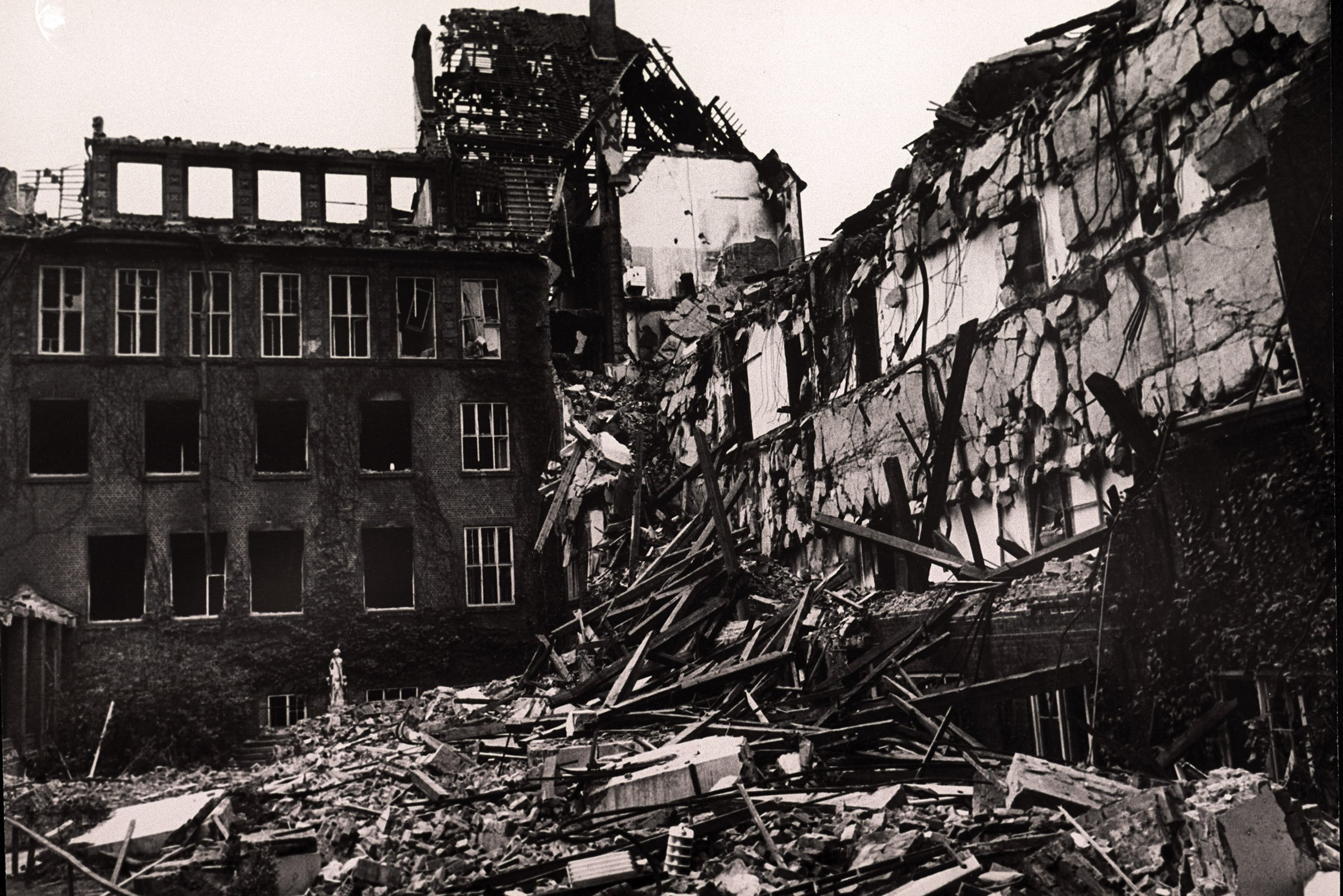
After its partial destruction in World War II, the building was restored, with the western wing of the horseshoe-shaped structure receiving a flat penthouse instead of a mansard roof. The completely preserved entrance with its decorative courtyard was removed in the 1950s in the spirit of “demonumentalization.” The open staircase with an arcade made of concrete and steel, erected on this site in 1993, is reminiscent of the old situation in its layout..
Auditorium
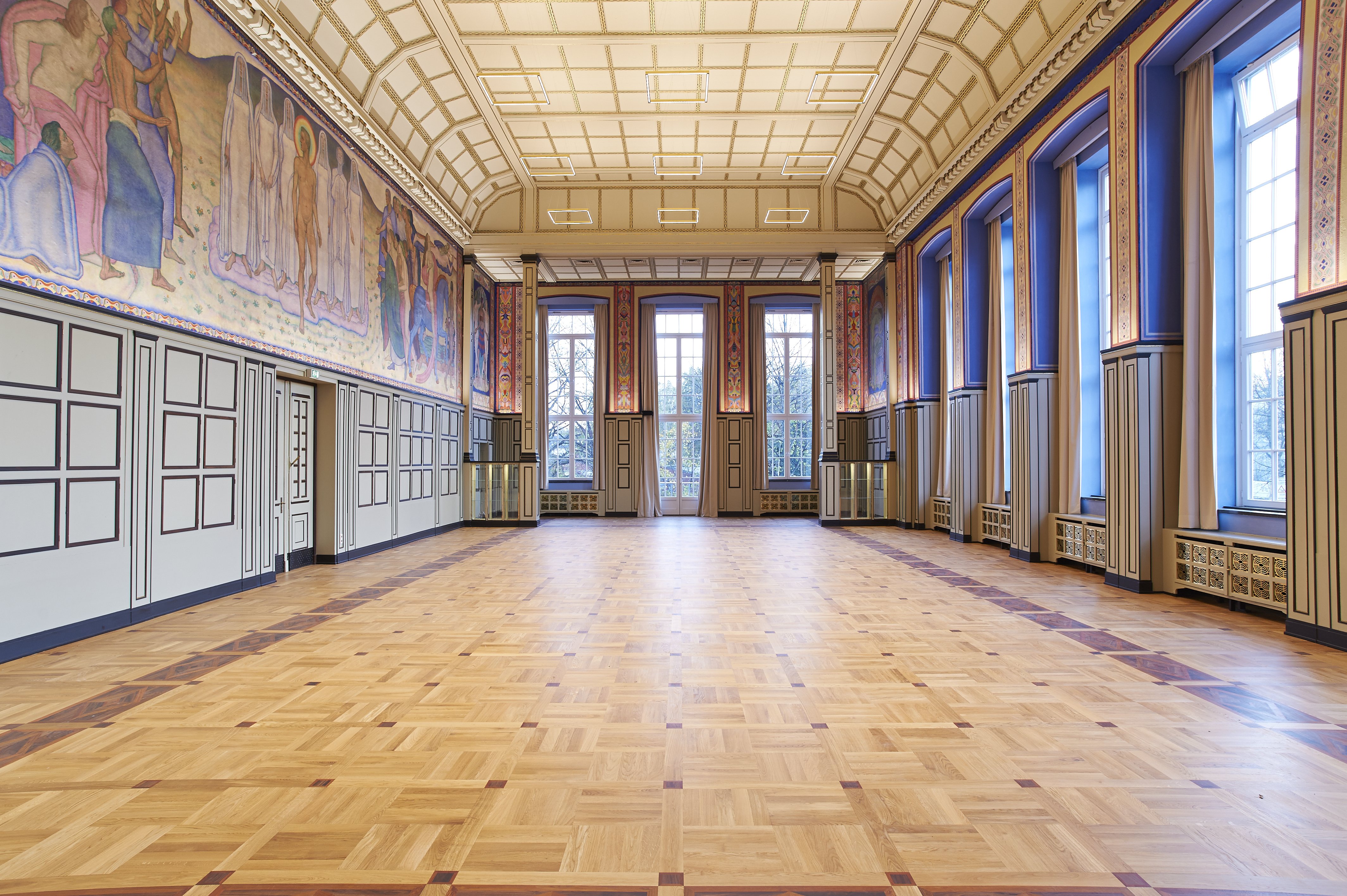
It is the centerpiece of the building inaugurated in 1913: the auditorium designed by Fritz Schumacher as an architectural Gesamtkunstwerk. Its colorful ornamentation had disappeared since the 1950s under a gray-white dispersion coating, and the space had suffered greatly from sometimes reckless use. 100 years later, just in time for the centennial celebrations of the building, this valuable main hall of the University of Fine Arts was completely restored and returned to its original condition.
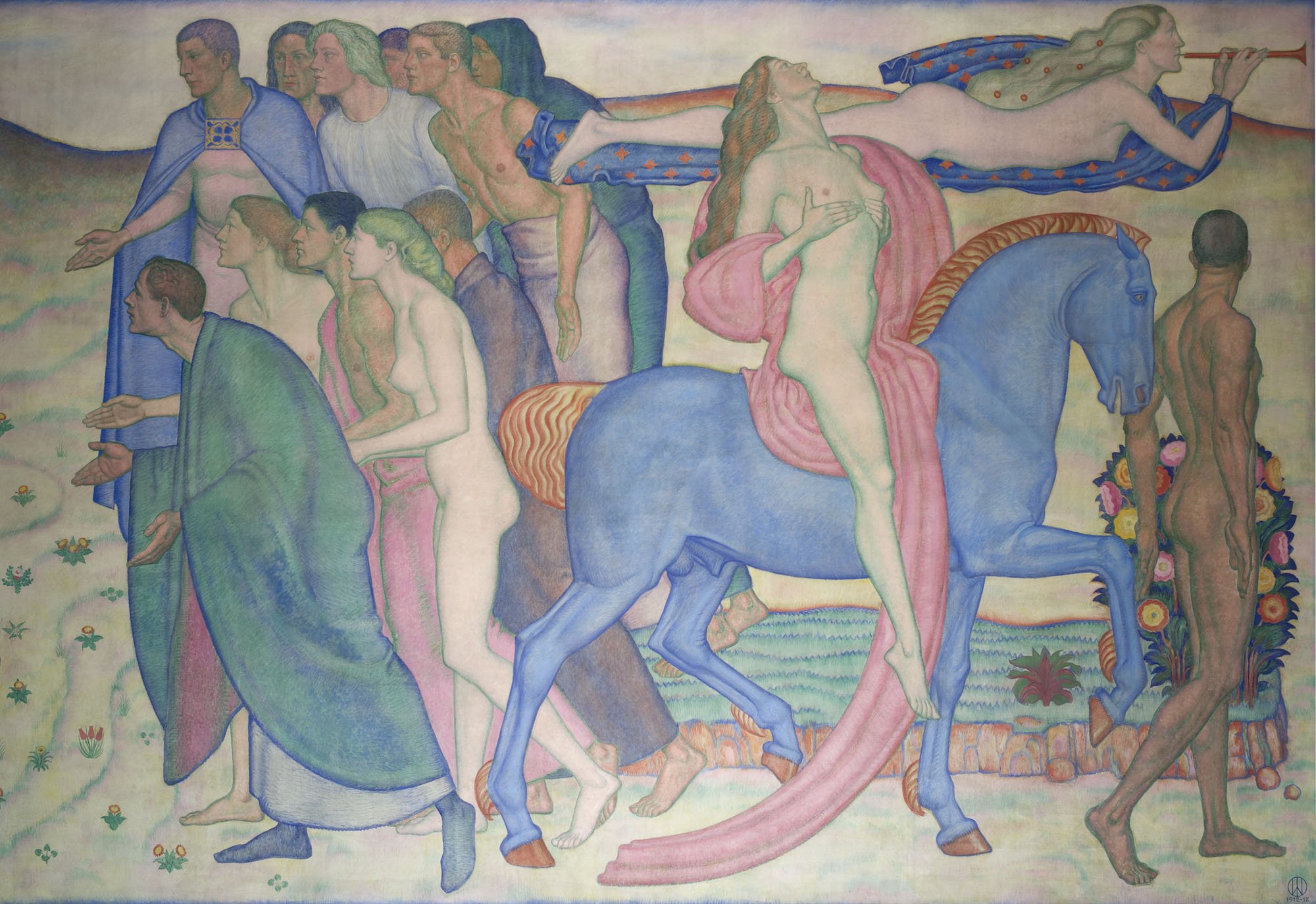
The full restoration took place over five years. In a first step, the HFBK was able to have the impressive monumental frieze Die ewige Welle repaired since 2008. The mural by painter Willy von Beckerath, which spans three wall surfaces in the auditorium and was created between 1912 and 1918, symbolically represents the rise and fall of a cultural epoch. Thanks to the support of the Stiftung Denkmalpflege Hamburg and funds from the German government’s Konjunkturprogramm II, the painting, which is 44 meters wide and 4 meters high, has been cleaned and restored so that it once again shines in its original blaze of color.
After initial color tests and, above all, the raising of the necessary funds, the comprehensive restoration and reconstruction of the interior architecture of the assembly hall could finally be tackled. The imposing room—24 meters long, 11 meters wide, with a ceiling height of 9 meters – is considered a unique synthesis of the arts consisting of painting and architecture, which was programmatically created in the spirit of a strengthened bourgeois self-confidence at the beginning of a new era, namely as a conscious counterpart to the historicizing town hall architecture with its Kaisersaal.
The architect, the world-famous Hamburg chief architect Fritz Schumacher, co-founder of the Deutscher Werkbund, based the art academy’s claim on the following: to promote young artists individually in such a way that they will one day have an all-embracing effect on life and society with their art.
Since the beginning of 2013, the craftsmen and restorers have been working intensively to revive the unique interior architecture with its lush decorative painting. They restored the ceiling panels, originally finely decorated with ornaments in black and gold, over an area of around 300 square meters. The wood paneling on the walls below the Beckerath painting with its 123 elaborate coffered doors was repaired and painted according to the original concept, as were the four room-dividing elements, each consisting of a display case and a column and likewise decorated with gold bands and black dots.
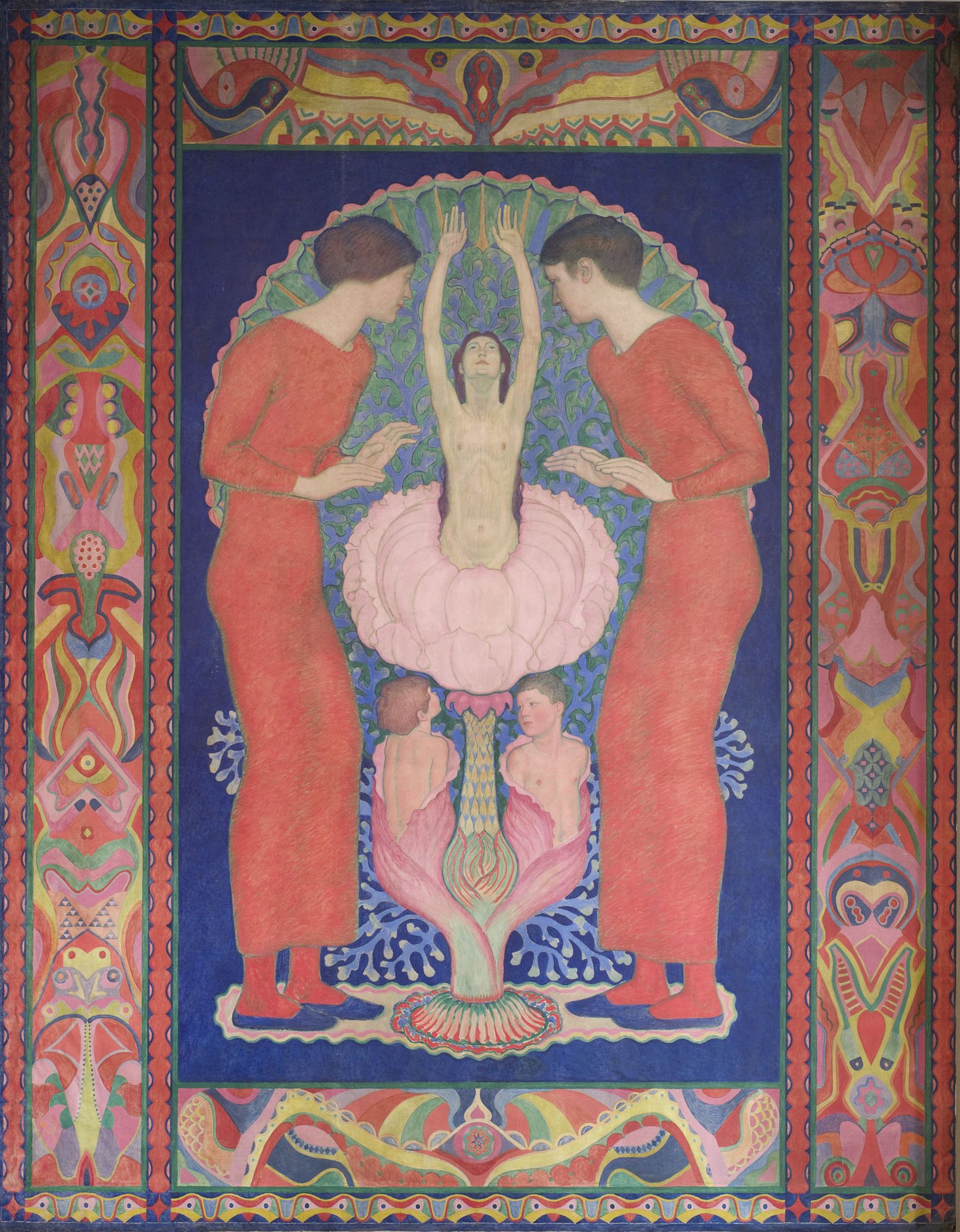
The window reveals, now painted blue again, and the multicolored ornamental bands between the windows and in the corners of the room are particularly eye-catching. The color scheme gives the auditorium a more festive feel again, as opposed to the sober impression of a “multi-purpose hall” that it had for the past 60 years. The once magnificent, but completely battered, oak strip parquet floor with a surrounding diamond pattern in wood of walnut was largely unsalvageable – it had to be completely replaced over an area of 250 square meters.
The enormous investment was only possible thanks to the generous support of the Hubertus Wald Stiftung in particular, as well as the Hermann Reemtsma Stiftung, the Stiftung Denkmalpflege Hamburg, the Hamburger Sparkasse and the Karl H. Ditze Stiftung.
On the part of the university, the project was supervised by Tillmann Bingel, the staff member responsible for building and construction matters.
The mural cycle “Die ewige Welle”
Willy von Beckerath’s mural frieze Die ewige Welle symbolically depicts the rise and fall of a cultural epoch in a sequence of 8 pictures. Von Beckerath taught from 1907 to 1931 at the Hochschule, then still the Staatliche Kunstgewerbeschule, and headed the class for “Figurative Mural Painting”. Influenced by the ideas of the reform movement, he advocated bridging the differences between “high” and applied art. For his main work, Die ewige Welle, von Beckerath aimed to merge architecture and painting by having the canvas embedded in the wall of the building in such a way that the latter becomes the base surface for the decorative painting.