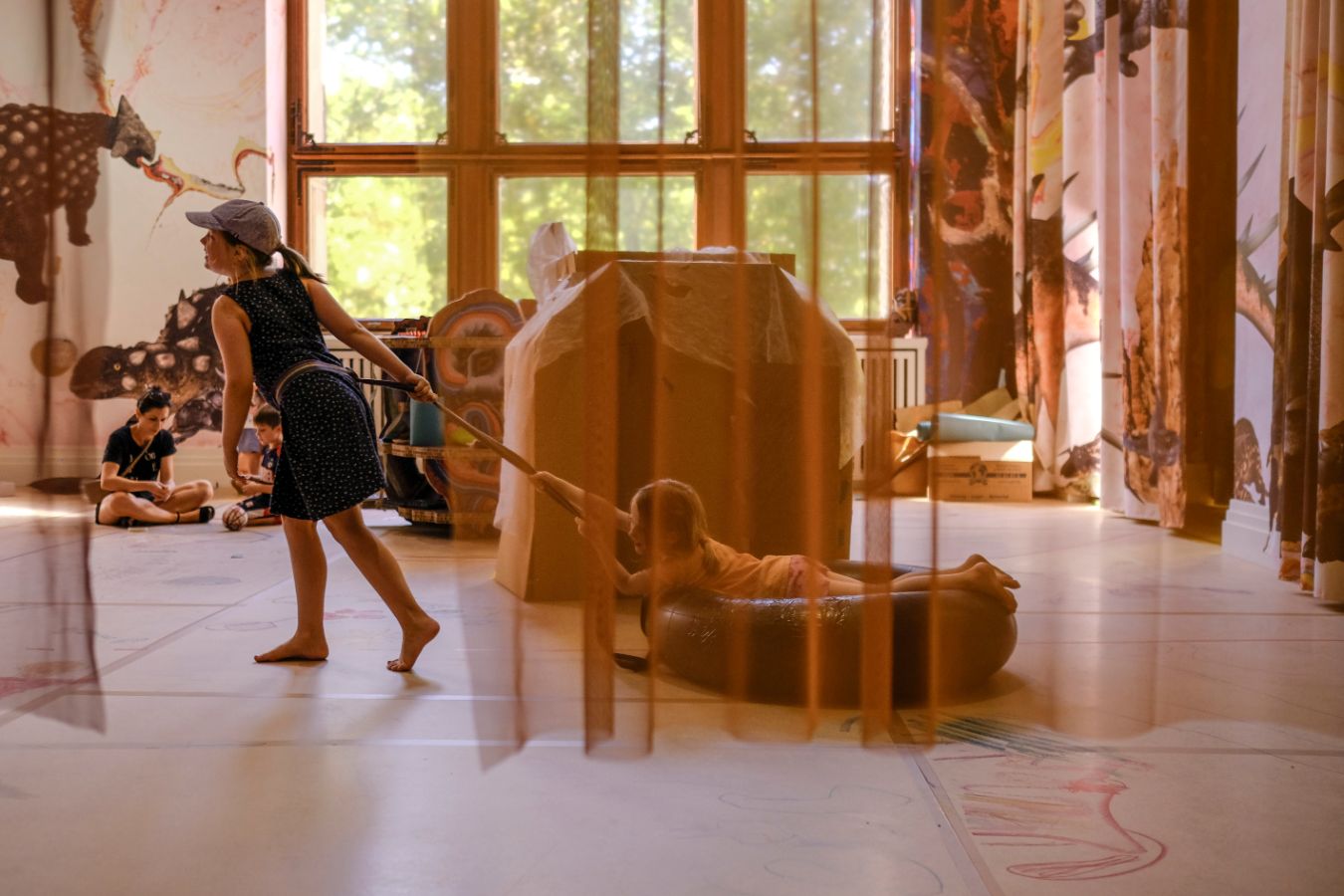
Kerstin Brätsch, BAUBAU, exhibition view, Gropius Bau, Berlin; photo: Guannan Li
Breaking Painting Apart as Ever – Joyful Reformation
In her multifaceted practice, Kerstin Brätsch redefines painting through collaborations, metaphysical imagery, and material experimentation. Louisa Elderton explores how Brätsch’s expansive works create a language of their own—fluid, ritualistic, and always in transformation.
Marbled inks that swirl as their own universe; striated oil paintings on huge sheets of transparent polyester; abstract shapes drawn atop one another, bursting with rainbow-hued, geometric energy; antique glass studded with candy-coloured jewels. These are just some of the forms that have evolved out of the eclecticism of Kerstin Brätsch’s twenty-year oeuvre. Brätsch is an artist who works in the service of metamorphosing different combinations of pigment and light, questioning painting from various standpoints. This is not to say that her diverse works are distinct from one another; rather, they are part of the same visual language that has slowly accumulated and transmuted over time.
Brätsch has continually redefined the parameters of painting, expanding the limits of what comprises the medium and, in turn, destabilising it to include installations, artistic interventions, and performances. In an interview for MoMA Magazine, Brätsch said “I like to compare my practice to the reproduction of cells within a human body”, one in which the form “starts to produce cells with small errors, and these mutating cells create altered expressions of the same idea.” 1 . Having used materials as wide-ranging as mosaic, marbling, stained glass, and oil paint on mylar, the lineage of Brätsch’s practice has wandered through an all-encompassing array of matter.
Born in Hamburg, Brätsch studied at Universität der Künste Berlin in the early 2000s, and moved to New York in 2005, where she received her Master’s degree from Columbia University in Fine Arts. And having won awards including the August Macke Prize (2014), the Edvard Munch Art Award (2017), and the Peill Prize (2020) Brätsch’s commitment to exploring just how far painting can be pushed has been recognised by numerous institutions.
Collaboration is inherent to Brätsch’s approach, and she has worked with a many other artists and artisans, as well as with psychics, shamans, and clairvoyants to draw out the metaphysical aspects of painting. As per her interview with ARTnews, in which she said “Sometimes, to build an image, you need four hands, two belonging to an artisan and two to the artist,”[Phyllis Tuchman, “German Artist Kerstin Brätsch Is Redefining What It Means to Be a Painter Today”, ARTnews, 25 August 2022, https://www.artnews.com/art-news/artists/kerstin-bratsch-gladstone-gallery-venice-biennale-1234637334/ (last accessed 5.9.2024).] Brätsch has regularly collaborated with the likes of Adele Röder, forming DAS INSTITUT in 2007, and with Debo Eilers as KAYA, and she has also cooperated with brothers Ei and Tomoo Arakawa, who are the UNITED BROTHERS.
DAS INSTITUT’s 2016 exhibition at the Serpentine North Gallery was centred on collaborative processes, drawing out the transformative properties and effects of light on bodies and spaces. Brätsch’s paper marbling works were mounted on temporary walls that had been left with their substructures visible at the edges. The paintings were reminiscent of everything from microscopic cells in the human body to geological strata to agate crystals. The complex and layered images comprised colours that suggested the elemental forces, inks swirling in galaxy-like patterns.
Some of Brätsch’s later paintings use similar techniques of marbling, including Unstable Talismanic Rendering _Schrättel (with gratitude to master marbler Dirk Lange) (2017), in which the title winks at spiritualism while water colour, pigment, and ink form vortex-like whirls of purple, blues, and oranges. Indeed, Brätsch further engaged with ethereal states for her 2022 exhibition at Gladstone Gallery, Die Sein: Para Psychics I, where the artist displayed Mandala-like colour pencil drawings made as part of a daily ritual of visualising her own psychic realm — a kind of interior clairvoyance. Take, for example, the oil on paper work calibrator (2022), where a matrix of purple lines is propelled from a hazy pink, green, and yellow surround to form a kaleidoscopic amalgam of soft shapes. A metaphysical inner space is externalized by Brätsch through a method of unconscious psychic automatism.
Clearly interested in the elemental forces of both our interior and exterior worlds, Brätsch’s more recent works have seen her making materials like stucco to simulate synthetic forms of marble that nonetheless suggest the passage of time and history. Employing a process called stucco marmo, a technique with origins in 17th Century Italy where plaster is mixed with pigment and glue to imitate marble, the artist arranges pigments and then repeatedly sands, fills air holes, polishes, and waxes the surface to create smooth planes that have somehow become their own fossilized forms. Brätsch underlines the sense that something historical may lay buried deep within these shapes, and has said, “I like to think of the plaster as breaking apart to form bones and body parts—ritualistic amulets that when placed together evoke an unknown language.”[Brätsch, “Marble”, MoMA Magazine (see note 1).]
In a special commission for the foyer of MoMA’s Terrace Café, Fossil Psychics for Christa, Brätsch’s stucco works are permanently installed around the café in configurations that conjure hieroglyphics and act as their own ancient language. With 35 of the reliefs installed across hand-painted blue, green, and pink tempera walls — which were made in collaboration with Italian decorative painters Valter Cipriani and Carolina d’Ayala Valva—the multi-coloured abstractions also seem to contain their own hidden faces, which surreptitiously gaze out at people as they pass by.
Continuing the theme of making work for functional spaces, most recently, Brätsch has collaborated with the Gropius Bau in Berlin to present BAUBAU. As a play area for children based on the principles of free play, the concept arose from the example of The Model, an adventure playground first shown at the Moderna Museet in Stockholm in 1968, which was designed by artist and activist Palle Nielsen and journalist and activist Gunilla Lundahl. Brätsch’s aesthetic sensibility for marbling and stucco have evolved to form elements including wallpaper, fabrics, seating, shapes, and soft surfaces that children can touch, climb upon, move around, and even layer as building blocks. The museum as a space of austere presentation with its ‘don’t touch’ mantra is upended in favour of inclusivity, play, and haptic experimentation. In the process, it is the children who become Brätsch’s active and ever-present collaborators.
Ultimately, Brätsch’s experiments with painting produce multiplicity. In a constant process of playful becoming, her works resonate within different social contexts and circulate as new arrangements to find mutable kinds of ever-joyful reformation.
Louisa Elderton is a Berlin-based writer and editor. She is currently the Managing Editor of ICI Berlin Press, and was formerly the Curatorial Editor at Gropius Bau and Editor-in-Chief of Side Magazine at Bergen Assembly.
- Kerstin Brätsch, Hanna Girma, and Tara Keny, “Marble: Dinosaurs aren’t just at the Natural History Museum… they’re also in a café at MoMA, thanks to Kerstin Brätsch”, MoMA Magazine, 19 February 2020, https://www.moma.org/magazine/articles/242#authors-tags (last accessed 3.9.2024) ↩